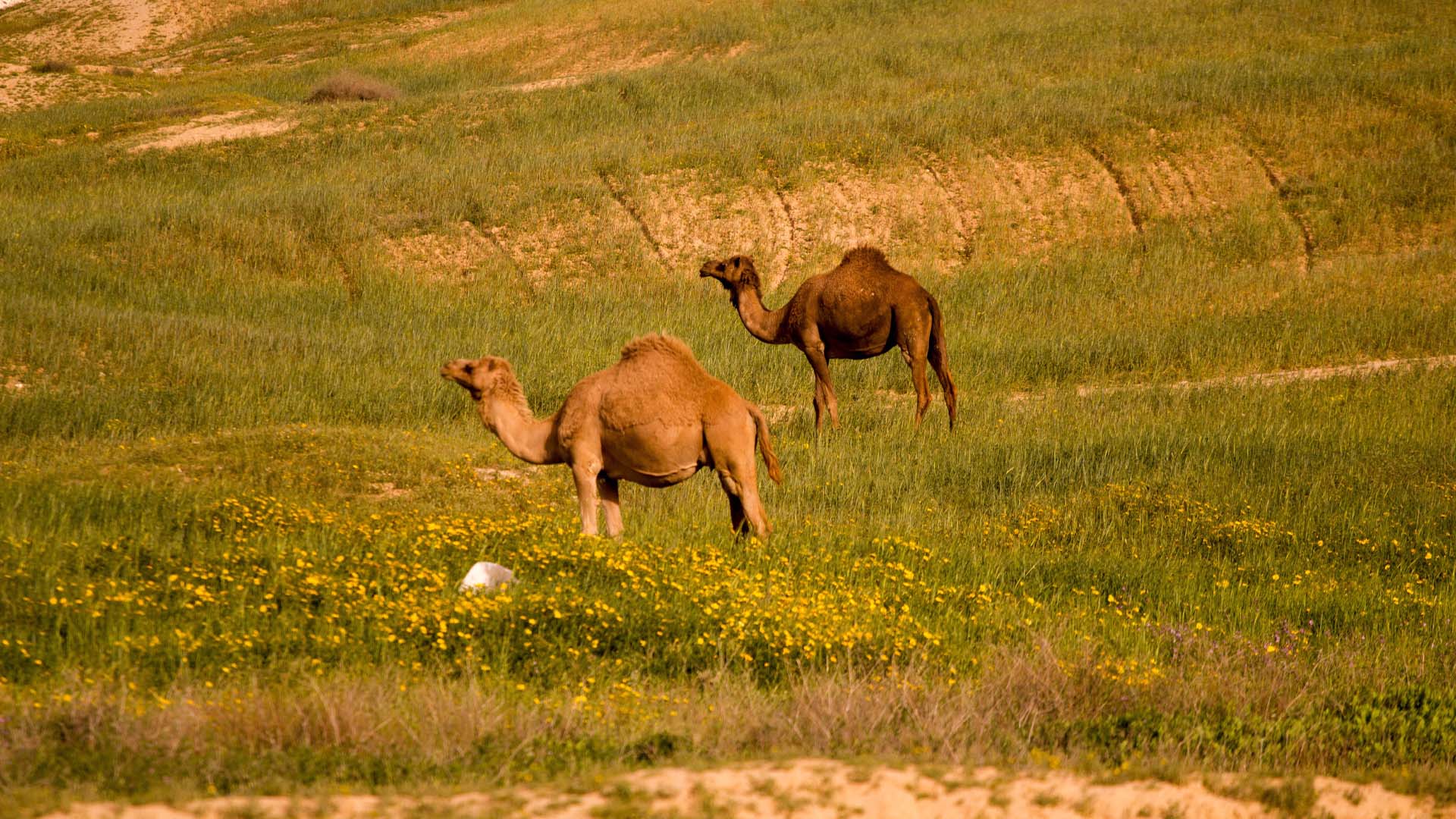
The Use of Camels and Donkeys in Bible, Quran and Modern Discoveries
The historical and scriptural significance of camels and donkeys has been a subject of interest for scholars and archaeologists alike. In the Old Testament, we find references to camels being used for transportation during the time of the Prophet Jacob (peace be upon him). In the story of Joseph (peace be upon him), camels are mentioned in the Book of Genesis in the Old Testament: "Then Jacob put his children and his wives on camels," [Genesis 31:17]. This text indicates that Jacob used camels to transport his family. However, the Quran does not mention camels as a means of transport in these narratives but refers to different animals, namely donkeys and "ba’eer" (which some interpret as camels, while others see it as donkeys).
In the Quran, it is stated: {When the caravan had departed, their father said, "Indeed, I find the smell of Joseph [and would say that he was alive] if you did not think me weakened in mind.”} [Yusuf: 94]. Al-Tabari, in his commentary, explains that when the term "caravan" (العير) is used, it refers to donkeys. Al-Qurtubi also cites Mujahid saying that their caravan consisted of donkeys.
Another verse states: {They said, "We are missing the measure of the king. And for he who produces it is [the reward of] a camel's load, and I am responsible for it."} [Yusuf: 72]. Al-Tabari explains this phrase, "a camel's load" (حمل بعير), by stating that it refers to a donkey's load, though some interpreters influenced by Israelite traditions believed it meant camels.
Al-Qurtubi’s commentary reflects this diversity of interpretation: "For he who produces it is a camel's load" could mean either camel or donkey, with some Arab dialects using "ba’eer" to refer to a donkey. Mujahid, among others, supported this interpretation.
Modern Scientific Study
The answer to why the Quran uses a term with dual meanings (camel and donkey) rather than explicitly mentioning camels lies in modern scientific findings. Recent research confirms the precision of the Quranic language and its alignment with historical facts. A study conducted on ancient camel bones found in various locations in the Middle East indicates that camels were first used for transportation around 930 BCE, which is long after the time of Prophet Jacob. This study shows that donkeys were the primary means of transport during Jacob's era, which aligns perfectly with the Quranic narrative and Mujahid’s interpretation.
A recent article on the National Geographic website states that camels were not domesticated in the Eastern Mediterranean until the 10th century B.C.—several centuries after they appear in the Bible. This indicates that camels were only domesticated by humans in the 10th century B.C., which predates their mention in the altered Torah by many centuries. This discrepancy suggests that some texts in the Torah were written centuries after Jacob's time and contradict scientific evidence.
The study highlights that the current version of the Torah mentions camels 47 times in connection with the prophets (Abraham, Jacob, and Joseph). However, radiocarbon dating of camel bones found in Palestine shows that the oldest bones date back to no earlier than 900-930 B.C. This sudden appearance of camels as a mode of transport suggests they were more efficient than donkeys, which had been used previously.
The study further suggests that camels were first domesticated and used for transport in the Arabian Peninsula around 1000 B.C. Examination of camel bones from this region reveals clear signs of stress and injuries from frequent use for travel and carrying loads.
Analysis of many camel bones from the Arabian Peninsula, dating back 9700 years, shows that these animals were wild, as their bones did not show signs of stress from repeated transport and carrying heavy weights. Therefore, the primary mode of transport during Jacob's time was donkeys. This finding aligns with the Quran's use of the terms "ba’eer" and "ʿeer," which, according to Mujahid's interpretation, refer to donkeys.
This modern study confirms the accuracy of the Quranic terminology and suggests that the biblical texts mentioning camels as a mode of transport during the time of Jacob were written much later and do not align with historical and scientific evidence.
Insights from Historical Linguistics
According to the Lisan al-Arab dictionary, Ibn Khallikan states, "The word 'ba’eer' can also mean 'donkey,' which is a rare usage I encountered in the court of Sayf al-Dawla ibn Hamdan. When asked by Ibn Khallawiyya, the poet Al-Mutanabbi struggled with the interpretation of 'ba’eer' in the Quranic verse, 'And for he who produces it is [the reward of] a ba’eer’s load.' The correct meaning here is 'donkey,' as Ibn Khallikan clarified, breaking Al-Mutanabbi's confidence."
This interpretation indicates that 'ba’eer' in the Quran refers to a donkey, especially considering that Jacob and his sons lived in Canaan, where camels were not present, and they used donkeys for transport. This is also supported by the scholar Mujahid and other classical commentators.
The Rational Explanation
How did Ibn Khallikan, the renowned linguist, know that 'ba’eer' in the Quran refers to a donkey? How did Mujahid know that donkeys were the means of transport in Jacob's time? It must have been knowledge passed down from earlier scholars, possibly from the Prophet Muhammad (peace be upon him) himself. If the Prophet had taken the Quran from previous scriptures, it would have been logical to use the word 'camel.' However, the Quran uses the word 'ba’eer,' which has multiple meanings (camel, donkey, mule), leaving room for future scientific discoveries and continuous miraculous insights.
The Miracle of Salih's She-Camel
We know that the tribe of Thamud lived thousands of years before Joseph. They were not accustomed to seeing a domesticated she-camel living among them. God sent them a she-camel as a clear sign, which ate and drank without causing harm. This was an extraordinary event at the time, but the tribe did not believe in the miracle and killed the she-camel, leading to their punishment.
The story of Prophet Salih (peace be upon him) in the Quran aligns with scientific evidence, showcasing the precision of the Quran's language and its compatibility with modern science—or rather, "science’s compatibility with the Quran, as the Quran is the foundation." Praise be to Allah for the blessing of Islam.
Note
Interestingly, this study was conducted by Jewish researchers. The researcher who proved the Torah's alterations is Israeli, and the study was conducted at an Israeli research center in Palestine, where Jacob's sons lived before moving to Egypt. This aligns with the Quran's narrative, highlighting the continual uncovering of the Quran’s miracles through scientific discoveries.
Reference